Evga 46 Out of 5 Stars 648reviews Evga Geforce Gtx 1080 Ti Sc2 Gaming 11gb Gddr5x Reviews
At a Glance
Expert'southward Rating
Pros
- Incredible gaming functioning, even at 4K
- EVGA's iCX cooling keeps temperatures and noise low
- Smaller than other custom GTX 1080 Ti cards
Cons
- Shroud design may exist divisive
Our Verdict
The GTX 1080 Ti SC2 uses EVGA's revolutionary iCX cooling technology to make the virtually potent consumer graphics card in the world even better. It'due south cool, placidity, and powerful.
Best Prices Today

$
Always since the monstrous $700 GeForce GTX 1080 Ti launched, the globe's been waiting to see what this beastly GPU was capable of in the easily of Nvidia's hardware partners. The Founders Edition delivered damn near uncompromising 60-fps performance at 4K resolution with everything cranked to 11, and that was with a lowly reference cooler and stock clock speeds. How far can factory-overclocked versions with strong custom cooling solutions get?
Well, for the start fourth dimension always, a graphics carte is so damn fast that it managed to largely push a game's bottleneck off of the GPU and onto the CPU in PCWorld's ferocious testing PC—while running 15 degrees or more than cooler than the Founders Edition.
And the EVGA GTX 1080 Ti SC2 ($720 preorder on Amazon) isn't even EVGA'due south fastest custom GTX 1080 Ti.
Damn.
Meet the EVGA GTX 1080 Ti SC2
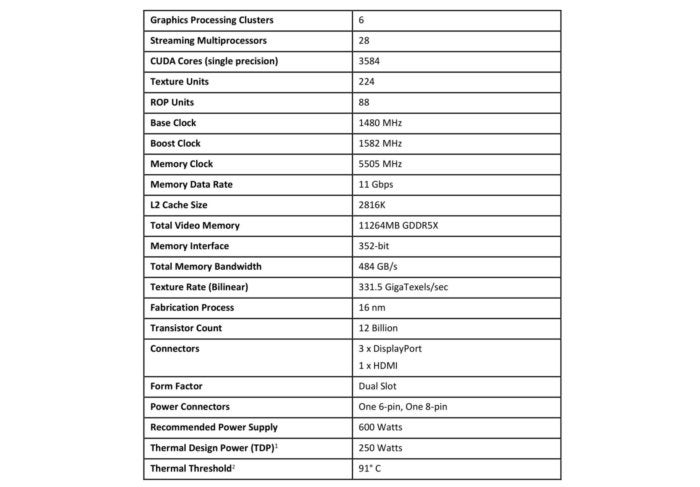
Before we dive into the customizations EVGA made to the SC2, here'southward a refresher on the GTX 1080 Ti's default technical specs, congenital around the full-fat version of Nvidia's GP102 graphics processor.
 Nvidia
 The major difference under the hood of EVGA's card is the GPU clock speed. The GTX 1080 Ti SC2 hums along at a one,556MHz base clock and 1,670MHz boost clock. That'southward a healthy 88MHz bound over the GTX 1080 Ti Founders Edition boost clock—heck, the EVGA card's base of operations clock is a mere 26MHz away from the stock version's boost clock. The numbers aren't equally physical every bit they seem, however, as the GTX 1080 Ti regularly surpasses its rated heave clock anyway. Earlier performing whatsoever boosted overclocking, we saw EVGA'due south card striking clock speeds upward to 1,850MHz in some games, depending on what was happening on-screen.
The memory's untouched compared to the reference version, with a borderline excessive 11GB of GDDR5X of onboard RAM. The cooling solution is annihilation only.
 Brad Chacos/IDG
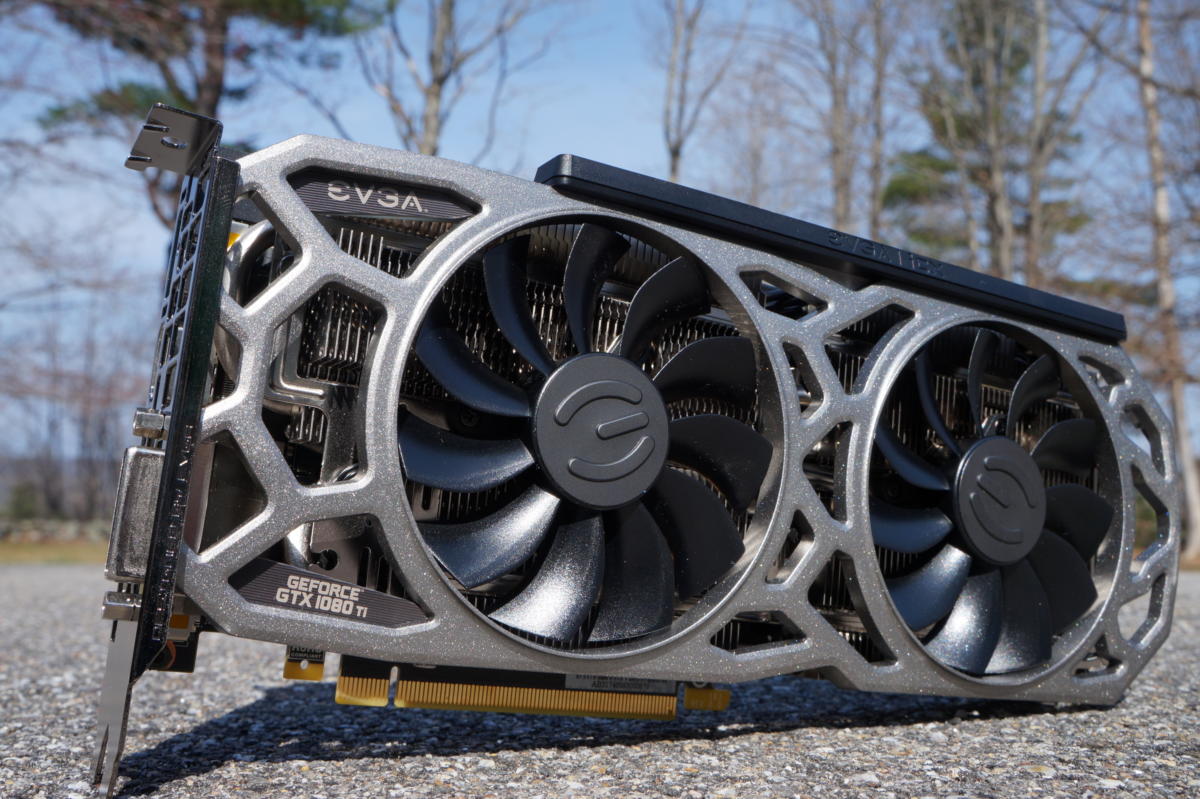
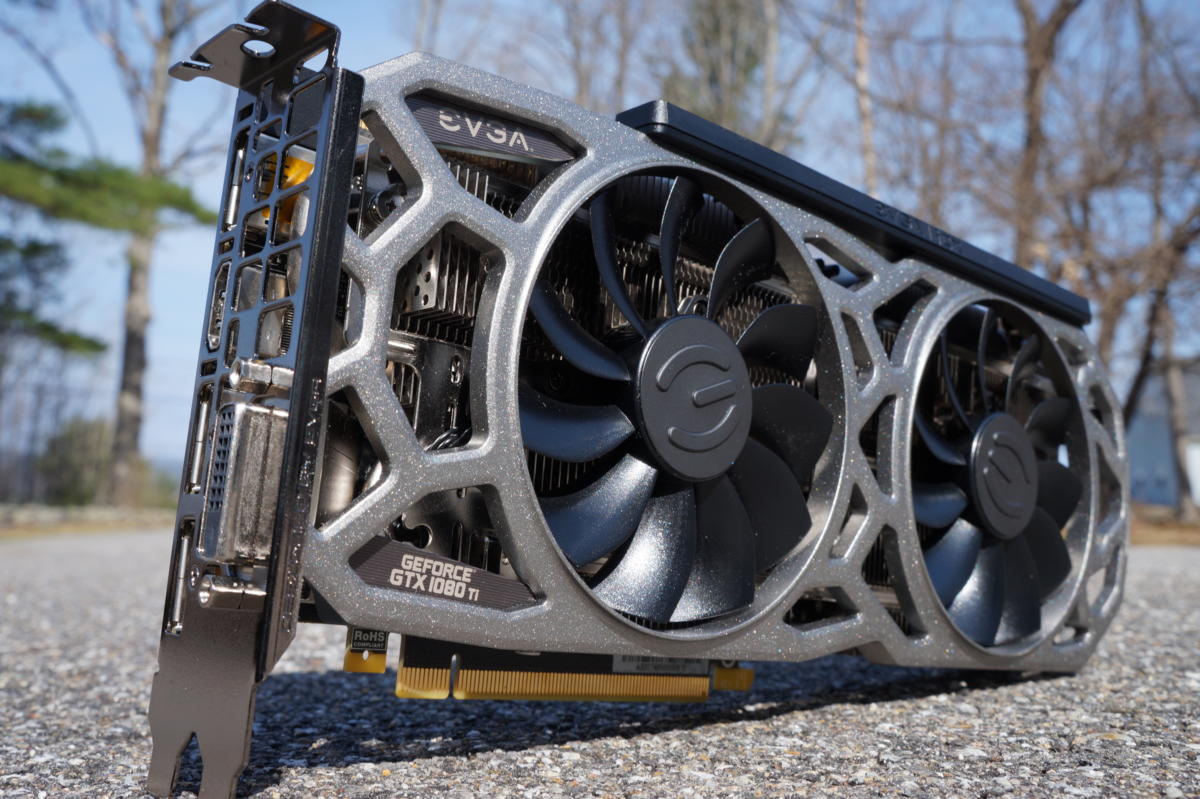
 You lot'll notice EVGA'due south new shroud pattern first. With the GTX 1080 Ti lineup, the company's ditched the solid exterior establish in its customized GTX 1080 models for a porous new artful that shows the beefy heatsink lurking underneath. The look's been somewhat divisive in forums but I dig information technology, not least of which because it shows the true star of the show here: EVGA's ambitious iCX cooling setup.
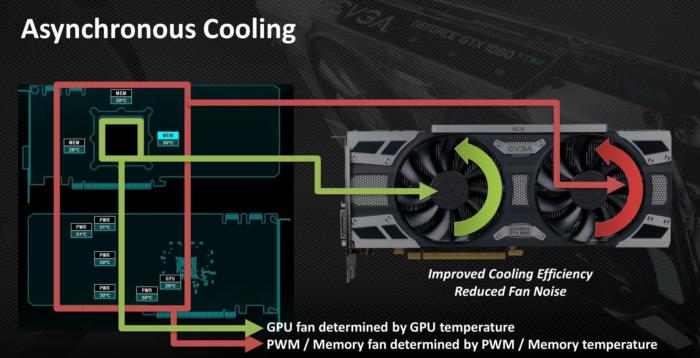
We went hands-on with EVGA'south revolutionary iCX when information technology debuted in the GTX 1080 FTW2 earlier this year, and it'southward worth highlighting once again. Graphics cards have traditionally only featured a unmarried temperature sensor, monitoring the GPU processor itself. EVGA'southward iCX loads the card with non ane, not 2, but nine boosted sensors that also monitors the rear of the GPU, the onboard retentivity modules, and the power controllers. Virtually every attribute of your graphics carte is tracked.
 EVGA
EVGA How EVGA'south iCX cooling technology works.
But iCX does more simply track temperatures. It uses that comprehensive information to control the speeds of the dual fans independently, with the leftmost fan responding to the GPU temperature, and the right-side fan adjusting speeds to keep the memory and PWMs cool. If the retention'south heating up rapidly but the GPU itself is staying relatively cool, as can happen with the Furmark stress test, the dedicated GPU fan maintains a slower, quieter speed, while the memory fan ramps upwards.
 EVGA
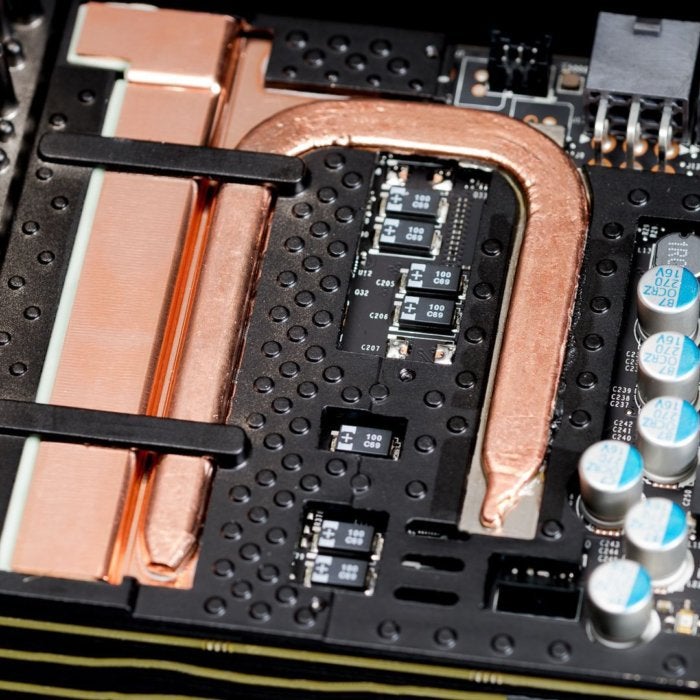
EVGA The copper VRM heatpipe integrated in the GTX 1080 Ti'southward redesigned baseplate.
EVGA'south tweaked the VRM heatpipe design on iCX-equipped GTX 1080 Ti cards likewise, to help go on temperatures even lower.
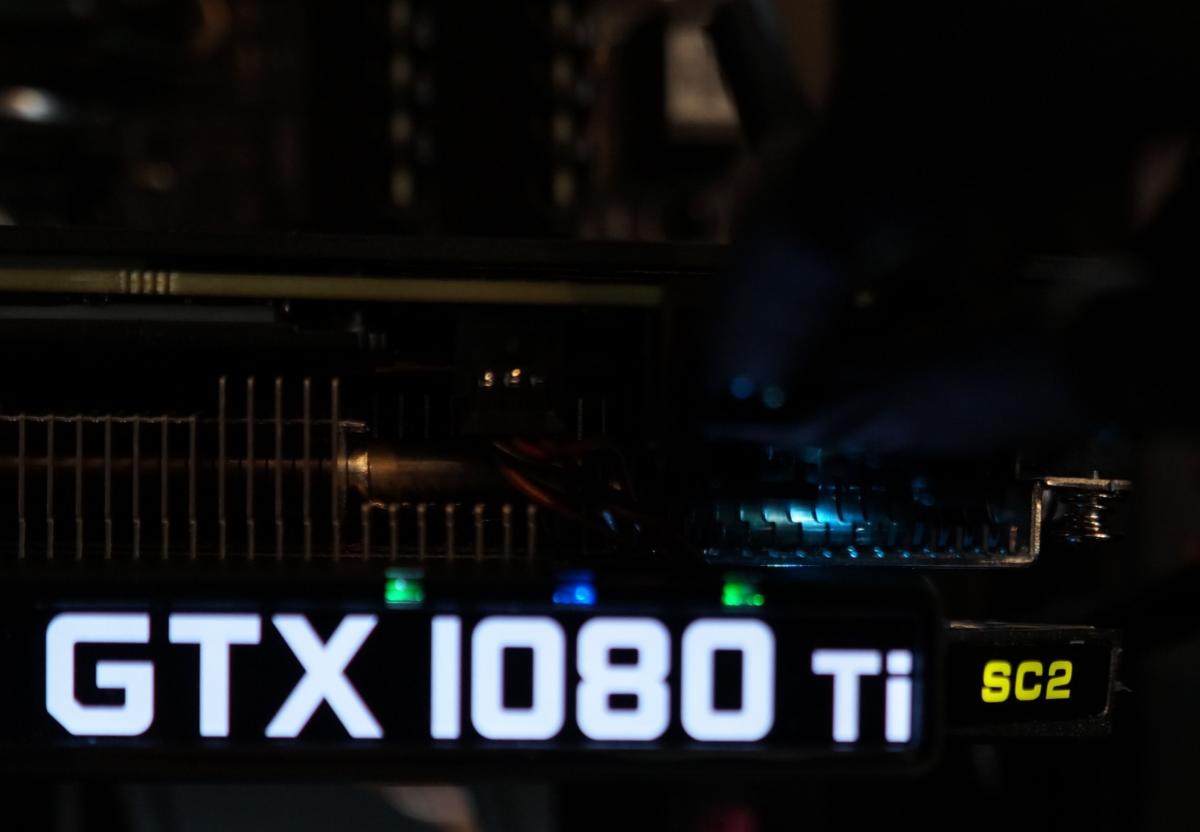
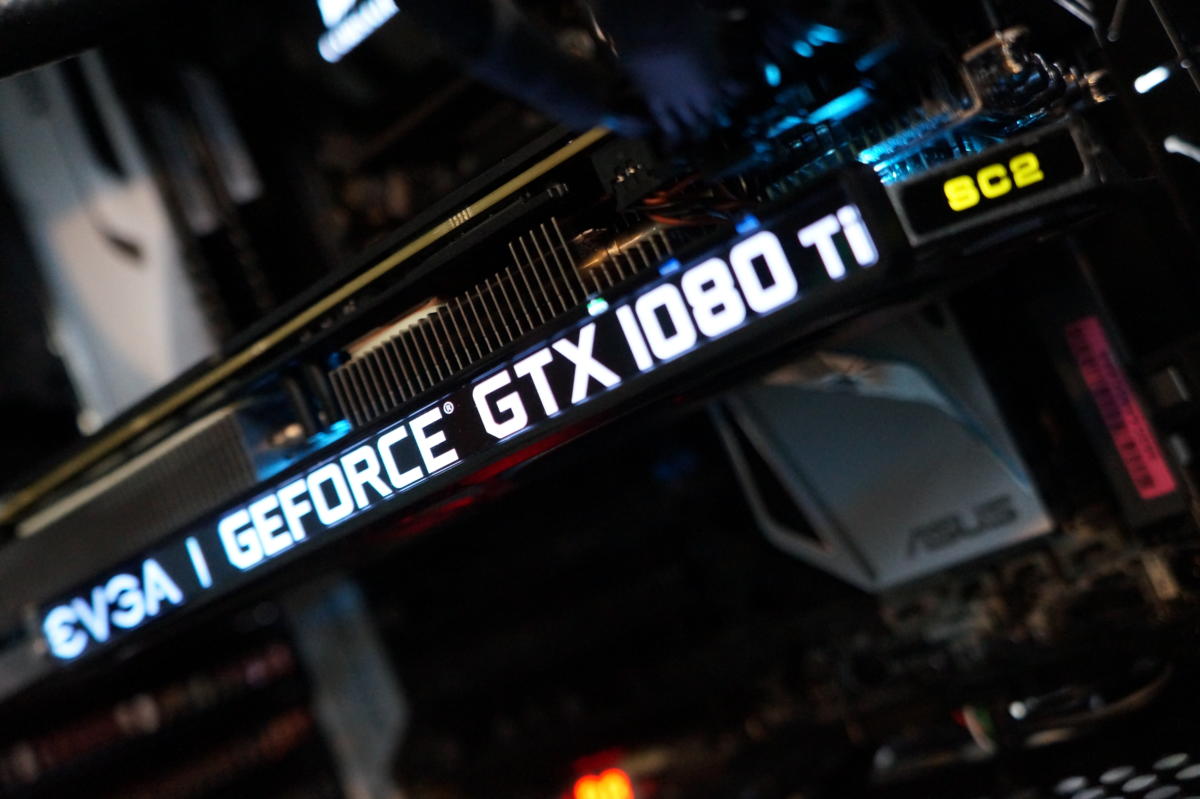
Yous can monitor your temperatures sensor-past-sensor in EVGA's Precision XOC software, or just by glancing at the graphics menu in your case. Three RGB lights above the EVGA GTX 1080 Ti SC2'due south logo on the carte du jour'south edge indicate how hot your GPU, PWMs, and retentiveness are, respectively. Equally components heat upwardly, the individual lights change color (not that you'll have to worry about information technology much with this card). Precision XOC lets you customize the colors of the EVGA logo too as the RGB indicators.
 Brad Chacos/IDG
 The colored lights over the "1080" testify how hot your hardware's running.
It feels like the hereafter of cooling, and information technology'south stunningly effective in practice. It'south dainty seeing RGB lights existence used to practical furnishings, besides. Virtually custom GTX 1080 Ti cards released thus far take used thicker 2.5- or 3-slot designs to keep the GPU tamed, but EVGA's card sticks to a traditional 2-slot size, so it'll be interesting to see how iCX holds up in games.
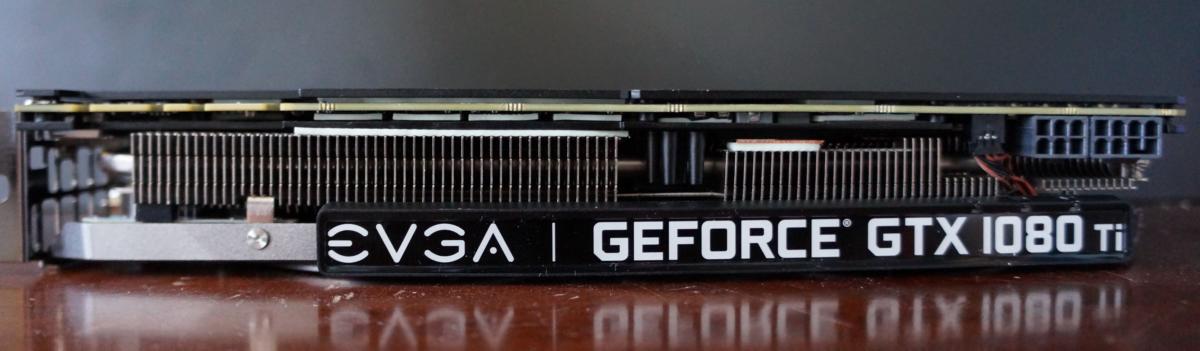
As far every bit the rest of the carte du jour goes, the EVGA GTX 1080 Ti SC2 features a sturdy backplate, as y'all'd expect in a graphics carte du jour this pricey. Despite its college clock speeds, the carte du jour still harbors the same 250-watt TDP every bit the Founders Edition, and the aforementioned 8-pin and 6-pin power connectors. EVGA's internal 7+2 power phases will help you push the GPU to even faster speeds.
 Brad Chacos/IDG
 There'south one final tweak of note. While Nvidia's GTX 1080 Ti Founders Edition ditched the DVI-D port to increment cooling while sticking to the aforementioned form factor as the GTX 1080 Founders Edition, EVGA's robust cooling organization allows the company to render the legacy, yet well-loved connector to its rightful place on the rear of the card.
Enough talk. Let's benchmark this badass. You're going to want to read the results for heat and Ashes of the Singularity.
Next page: System configuration, benchmarks begin
Our exam system, Division benchmarks
We tested EVGA's GTX 1080 Ti SC2 on PCWorld's dedicated graphics menu benchmark system. Our testbed's loaded with high-end components to avoid bottlenecks in other parts of the organisation and show unfettered graphics operation. At least, theoretically. We'll become to that later.
- Intel's Cadre i7-5960X with a Corsair Hydro Serial H100i airtight-loop water libation ($120 on Amazon).
- An Asus X99 Deluxe motherboard ($230 on Amazon for an updated version).
- Corsair'south Vengeance LPX DDR4 retention ($130 on Amazon), and i,200-watt AX1200i ability supply ($310 on Amazon).
- A 480GB Intel 730 series SSD ($280 on Amazon).
- Phanteks' Enthoo Evolv ATX example ($190 on Amazon).
- Windows 10 Pro ($158 on Amazon).
Naturally, we're comparison the EVGA GTX 1080 Ti SC2 confronting Nvidia'due south GTX 1080 Ti Founders Edition ($700 on Amazon). We already know that the GTX 1080 Ti stomps all rivals, but we're besides including benchmarks from the Founders Edition GTX 1080 ($500 on Amazon) and GTX 1070 ($380 on Amazon) for reference. AMD hasn't had a competitive enthusiast-class graphics carte du jour since Nvidia'south GTX ten-series launched in mid-2016, and information technology won't until Radeon Vega hits the streets sometime before the finish of June.
All cards are tested with default fan profiles and out-of-the-box clock speeds.
Each game's tested using its in-game criterion at the mentioned graphics presets, with V-sync, frame rate caps, and all GPU vendor-specific technologies—like AMD TressFX, Nvidia GameWorks options, and FreeSync/K-Sync—disabled. This card is so powerful that nosotros're limiting our testing to 4K and 2560×1440 resolution.
The Division
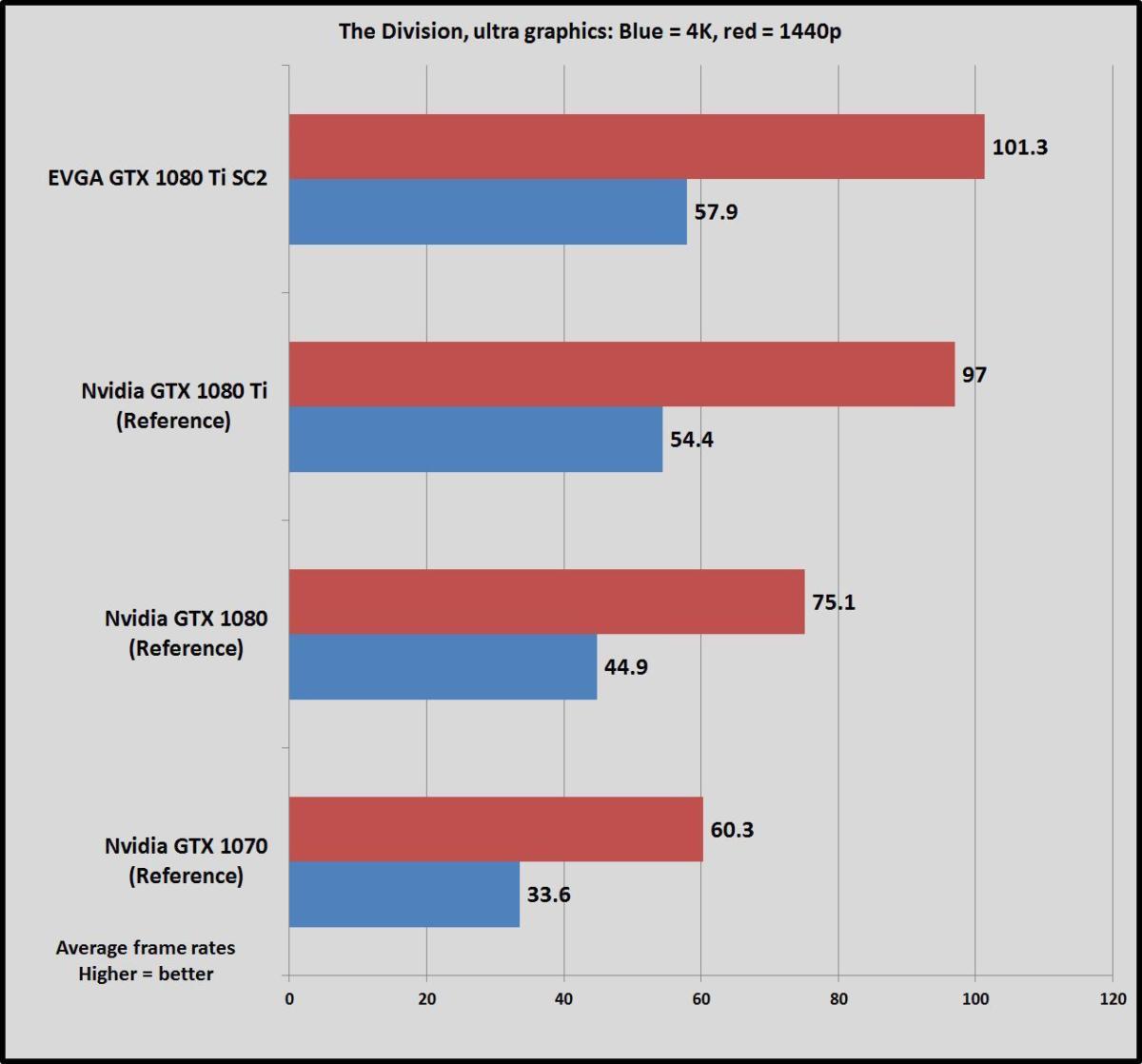
The Division, a gorgeous 3rd-person shooter/RPG that mixes elements ofDestinyandGears of State of war, kicks things off with Ubisoft's new Snowdrop engine. We test the game in DirectX 11 style; The Division recently rolled out an update that adds DirectX 12 support, but the performance is virtually identical to the DX11 results.
 Brad Chacos/IDG
 The EVGA card pushes a few more frames per 2d than the stock GTX 1080 Ti hither, with a wider gap as resolution increases. It pulls ahead by roughly half-dozen.5 percentage at 4K, but just 4.5 percent at 1440p.
Next page: Hitman
Hitman
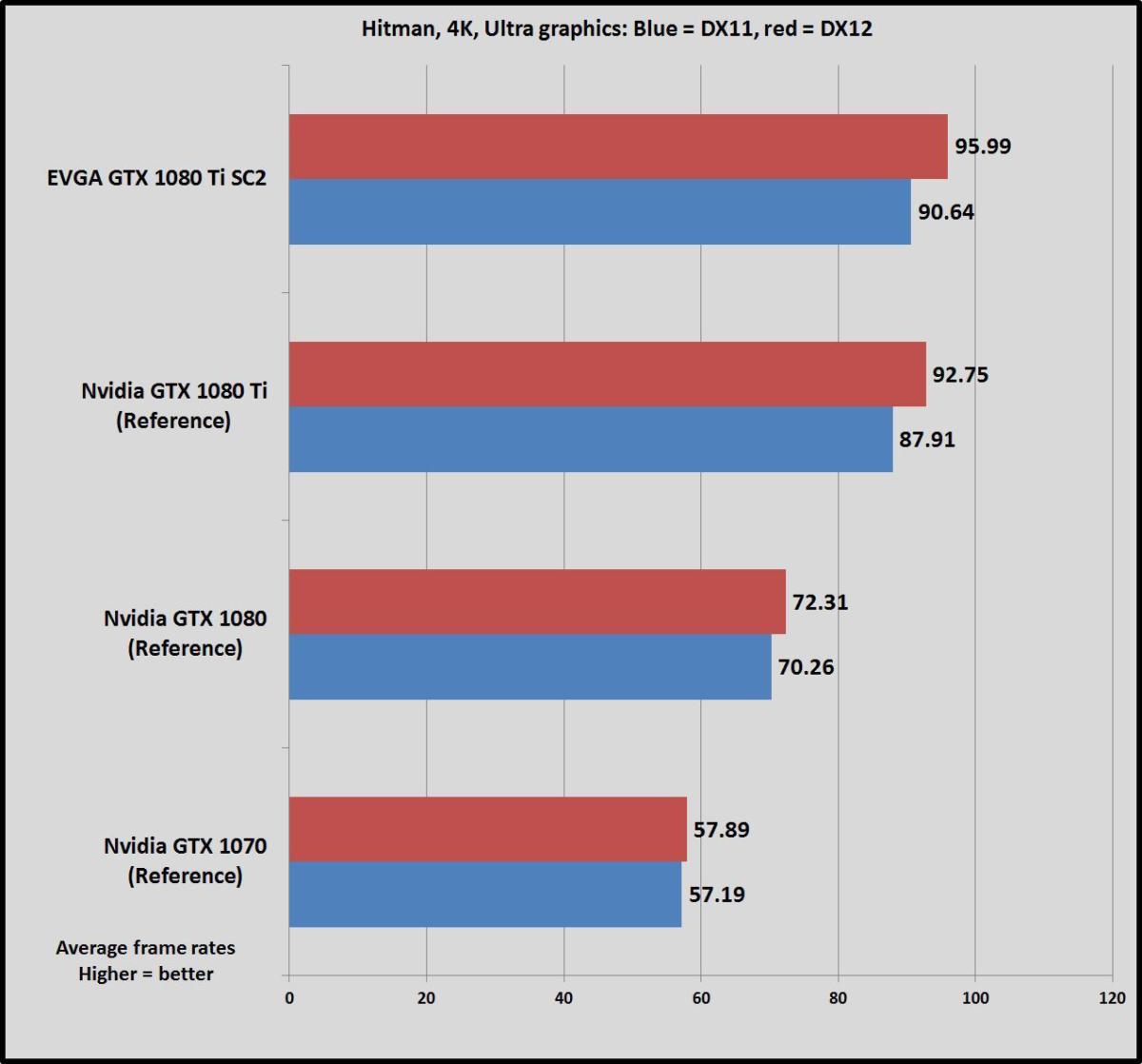
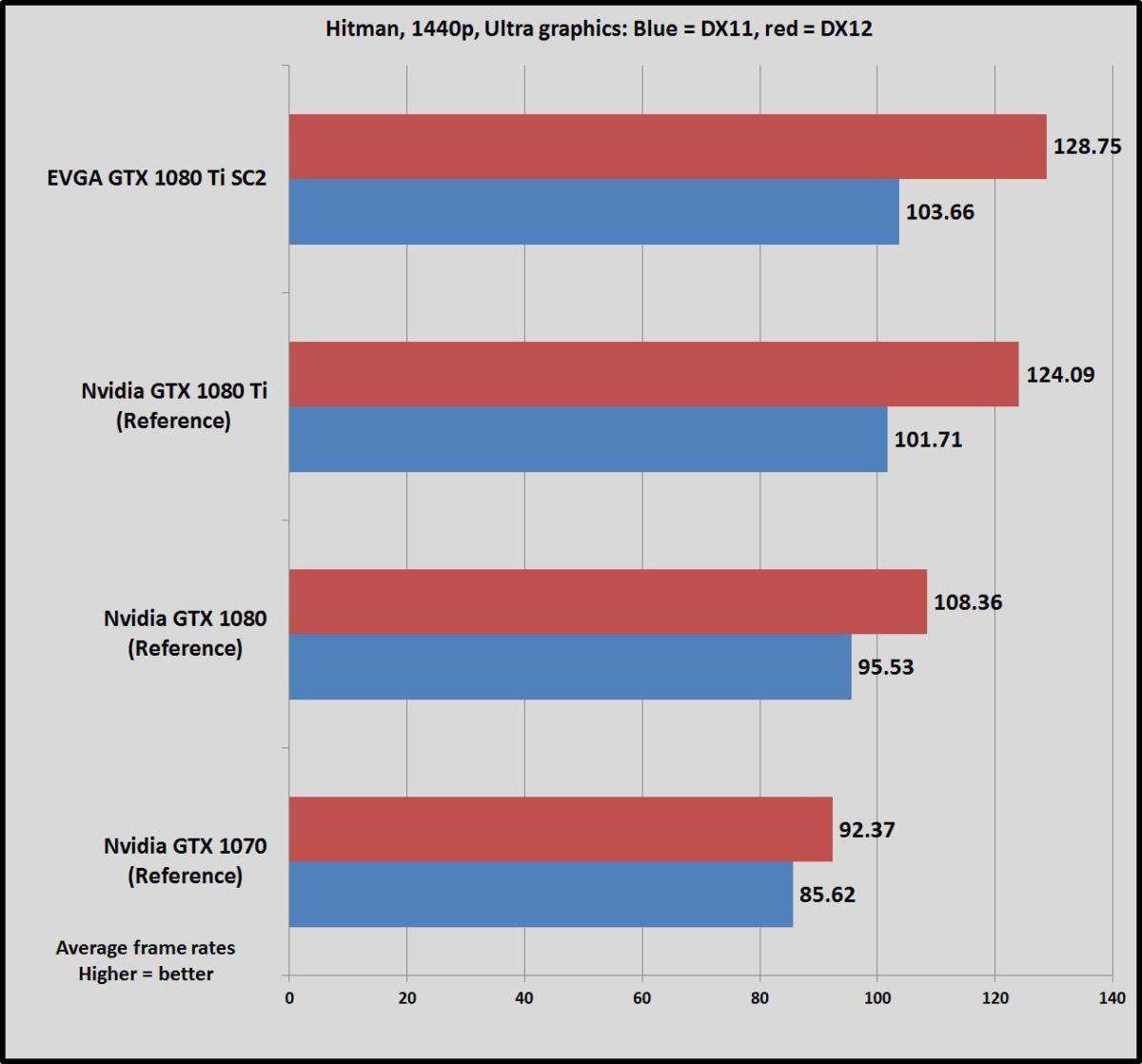
Hitman'south Glacier engine historically favored AMD hardware. It's no surprise;Hitman's a flagship AMD Gaming Evolved championship. That said, GeForce cards certainly don't slouch later contempo driver optimizations. Nosotros examination in both DirectX xi and DirectX 12 with SSAO disabled.
 Brad Chacos/IDG
  Brad Chacos/IDG
 The EVGA GTX 1080 Ti SC2'southward lead is less hither, peradventure because Hitman'southward already pushing out and then many frames. Nosotros saw roughly iii to four percent performance improvements over the GTX 1080 Ti Founders Edition at stock clock speeds—only a lot of people don't buy a card like this to stick to stock speeds.
Side by side page: Rising of the Tomb Raider
Rise of the Tomb Raider
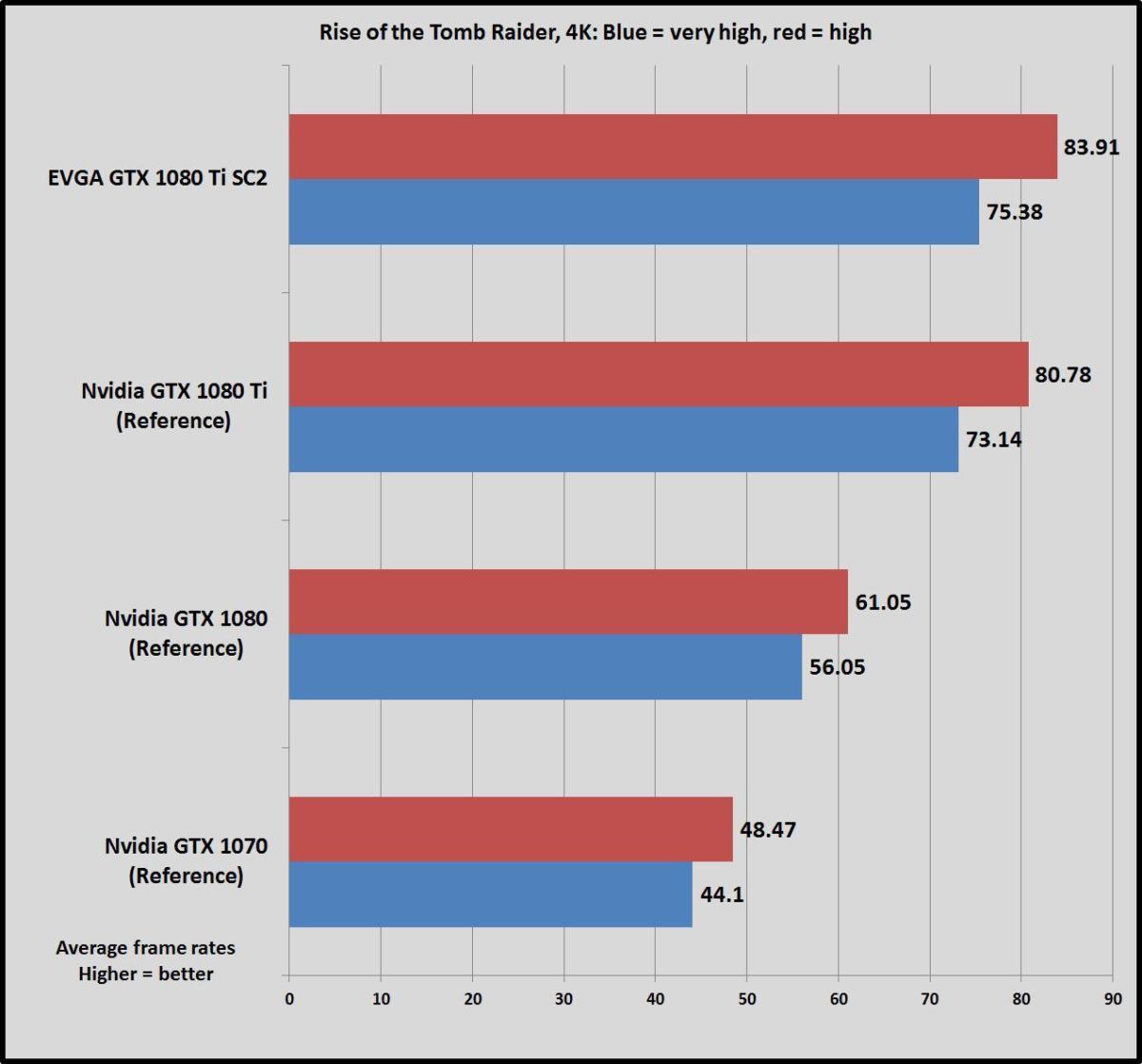
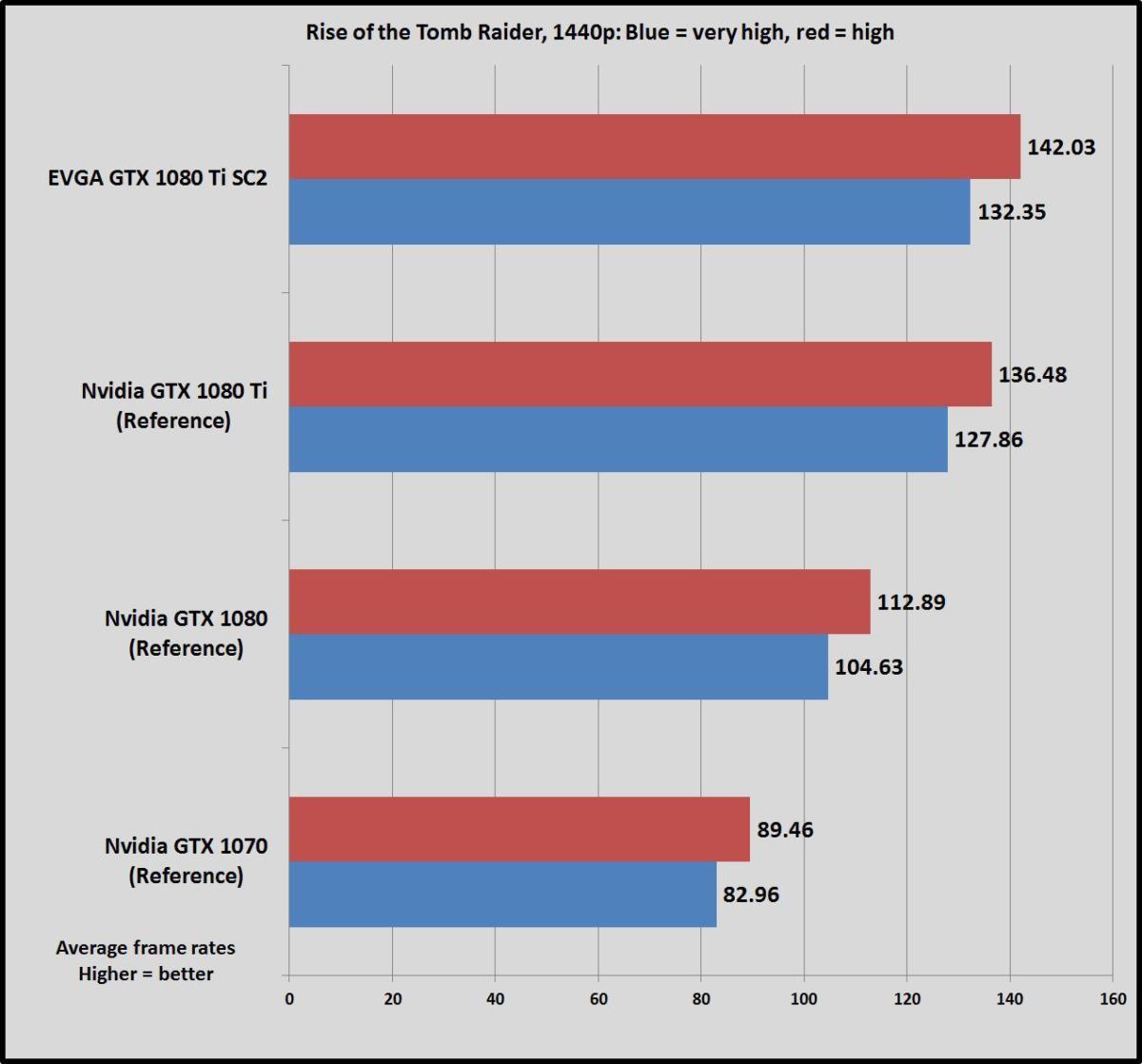
WhereasHitmanleans towards Radeon GPUs,Ascent of the Tomb Raiderperforms much better on GeForce cards—and information technology's admittedly gorgeous. Nosotros merely test the game's DirectX eleven mode, as DX12 results can be erratic.
 Brad Chacos/IDG
  Brad Chacos/IDG
 Once again, we saw a three to 4 percent improvement across the board going from the Founders Edition to the EVGA GTX 1080 Ti SC2.
Next page: Far Cry Primal
Far Cry Primal
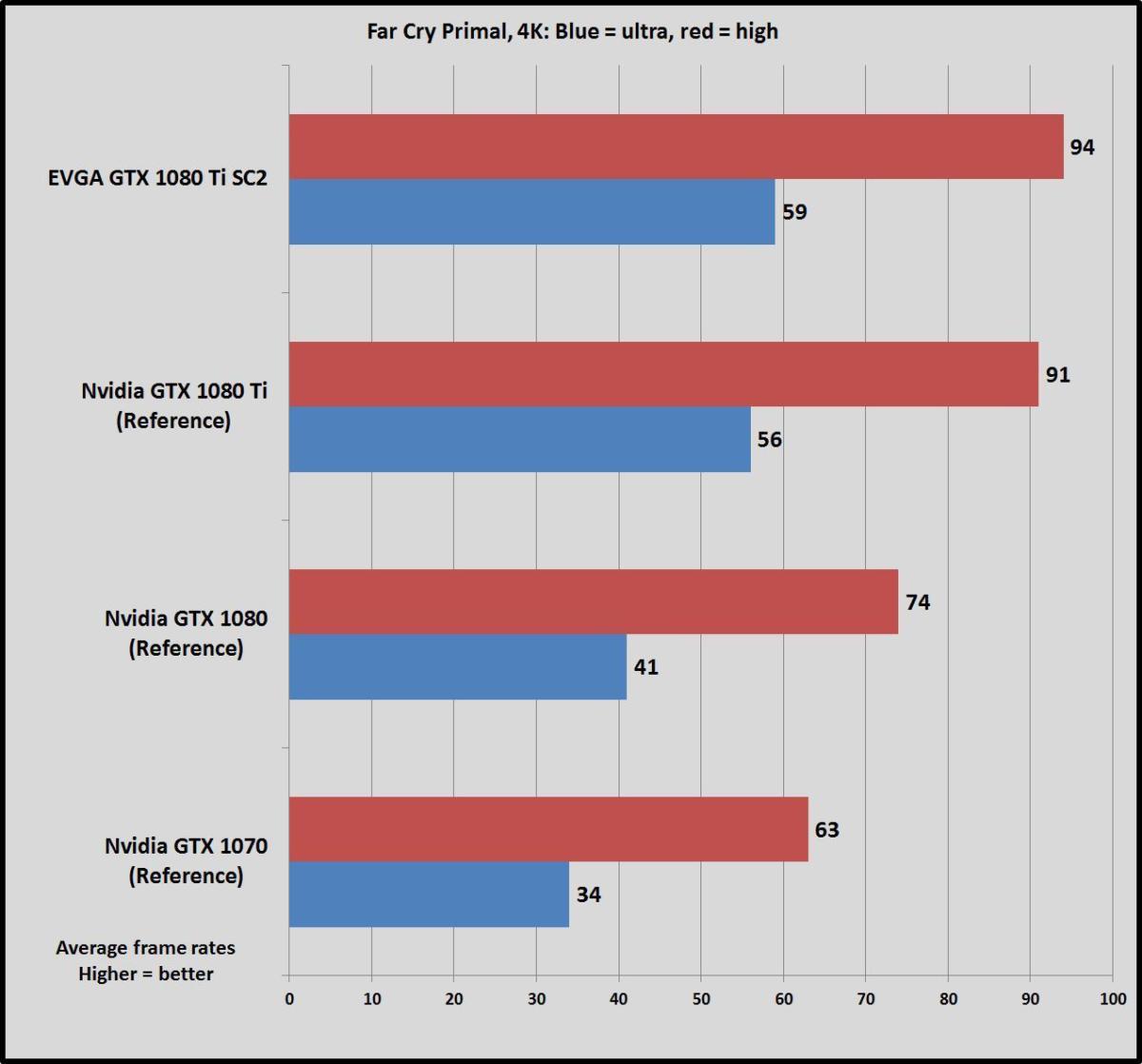
Far Weep Keyis another Ubisoft game, but it'southward powered by a different engine than The Division—the latest version of the long-running and well-respected Dunia engine.
 Brad Chacos/IDG
  Brad Chacos/IDG
 Another game, another comeback of a few frames per 2d over the stock GTX 1080 Ti. At 4K/Ultra, the deviation is v.36 percent.
Next page: Ashes of the Singularity
Ashes of the Singularity
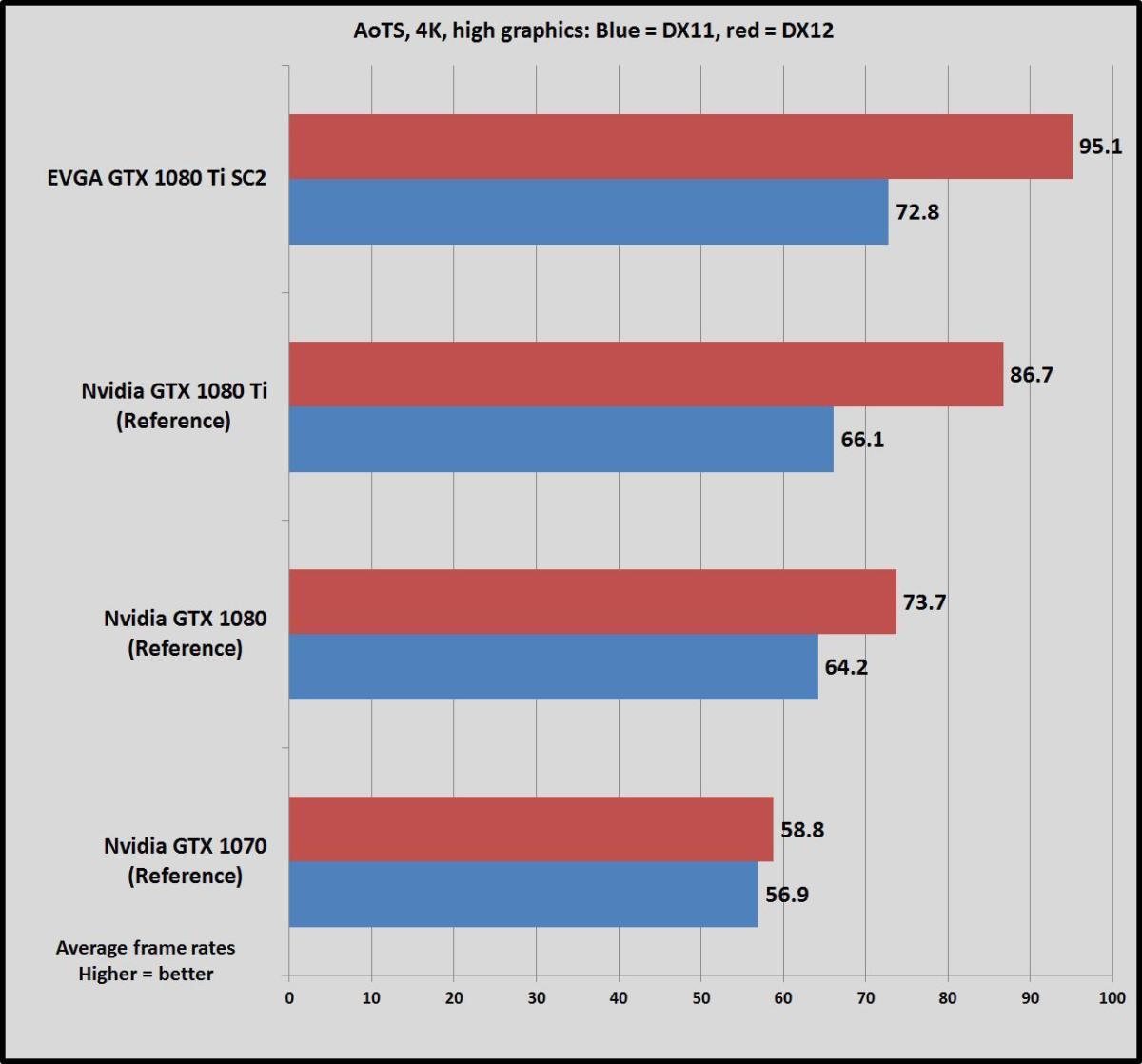
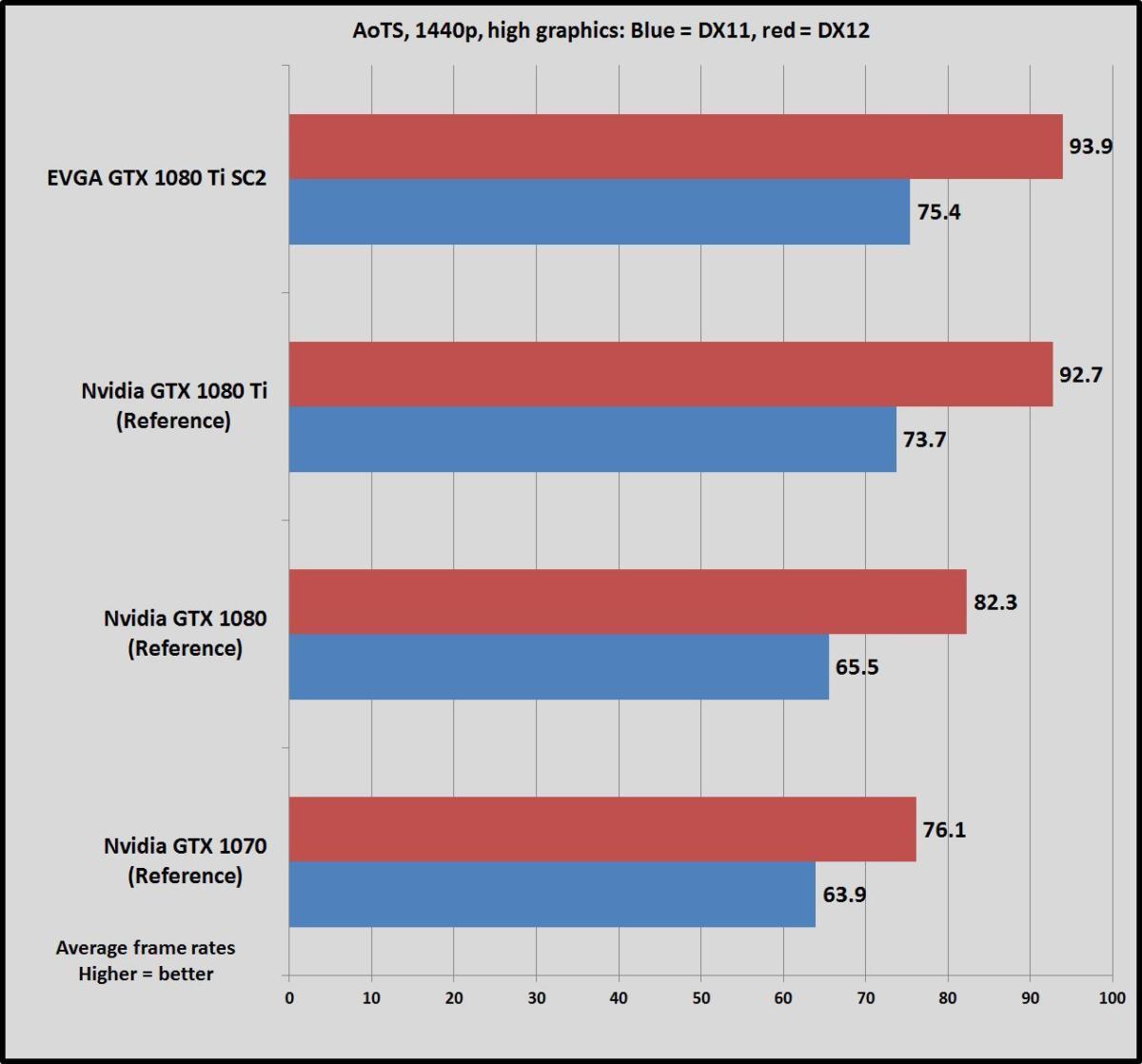
Ashes of the Singularity, running on Oxide'south custom Nitrous engine, was an early standard-bearer for DirectX 12, and many months later it'southwardall the same the premier game for seeing what next-gen graphics technologies have to offering. We exam the game using the High graphics setting, every bit the wildly strenuous Crazy and Extreme presets aren't reflective of existent-globe usage scenarios.
 Brad Chacos/IDG
  Brad Chacos/IDG
 Here'southward where things get really interesting. The EVGA GTX 1080 Ti SC2 sees the biggest performance uptick of all the tests in Ashes, pushing out frames a total x percent faster than the Founders Edition at 4K resolution. But wait at those 1440p results! They're virtually identical between the ii cards, and remained so after several tests.
That's because the EVGA GTX 1080 Ti SC2 is then fast, Ashes becomes CPU-bound rather than GPU-spring at 1440p/High—the get-go fourth dimension we've seen a graphics carte max out our system's capabilities. The SC2's extra oomph pushes it over the border, as confirmed by checking the game's deeper metrics, which showed that but about 5 percent of heavy- and medium-batch frames were GPU-bound. To be fair, the 8-cadre Cadre i7-5960X in our examination organization runs at modest 3GHz stock speeds, but information technology'south still a milestone. We'll be making some changes soon to prevent it from happening once more.
Next page: Synthetic benchmarks
Synthetics, power, heat, overclocking
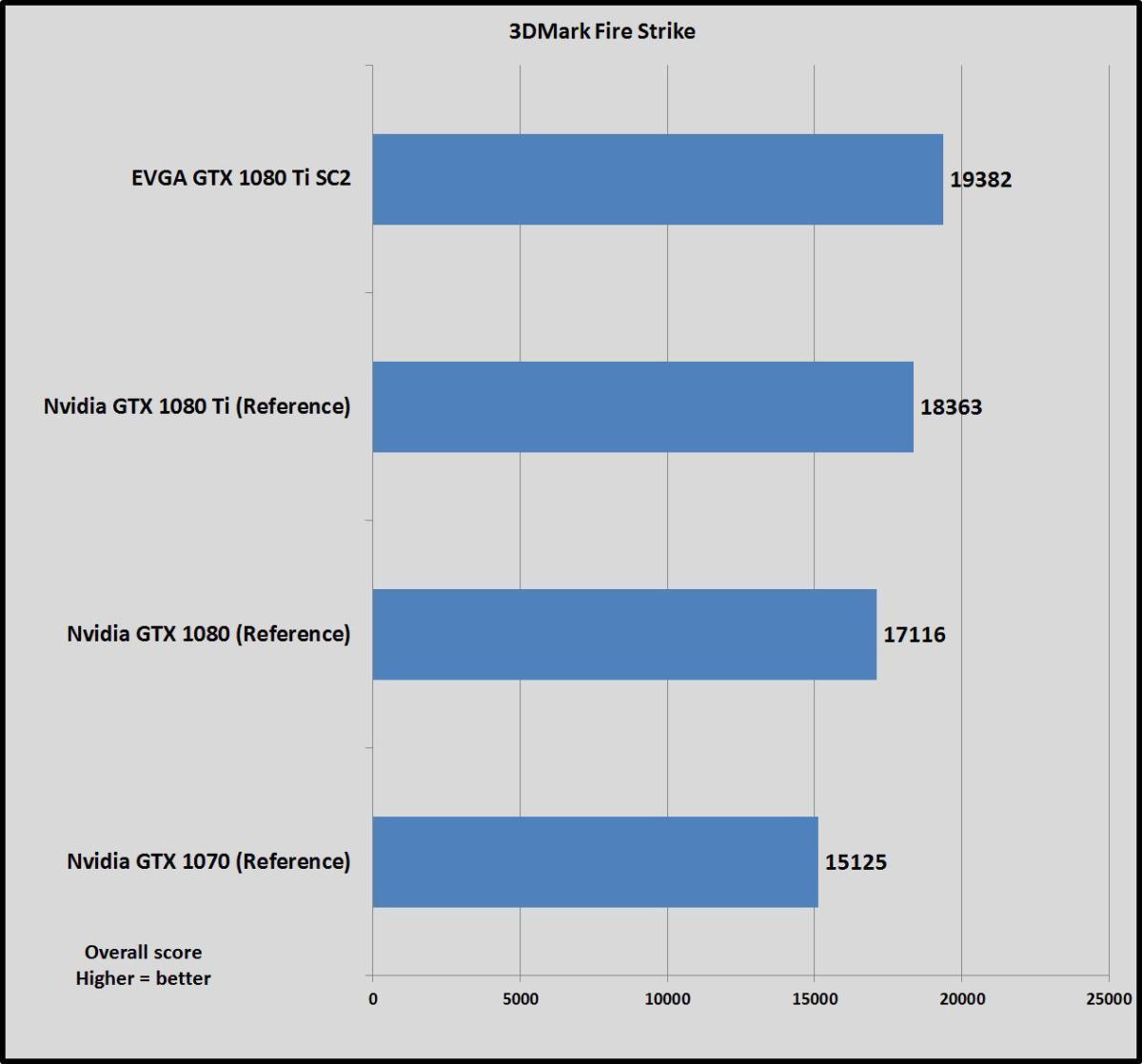
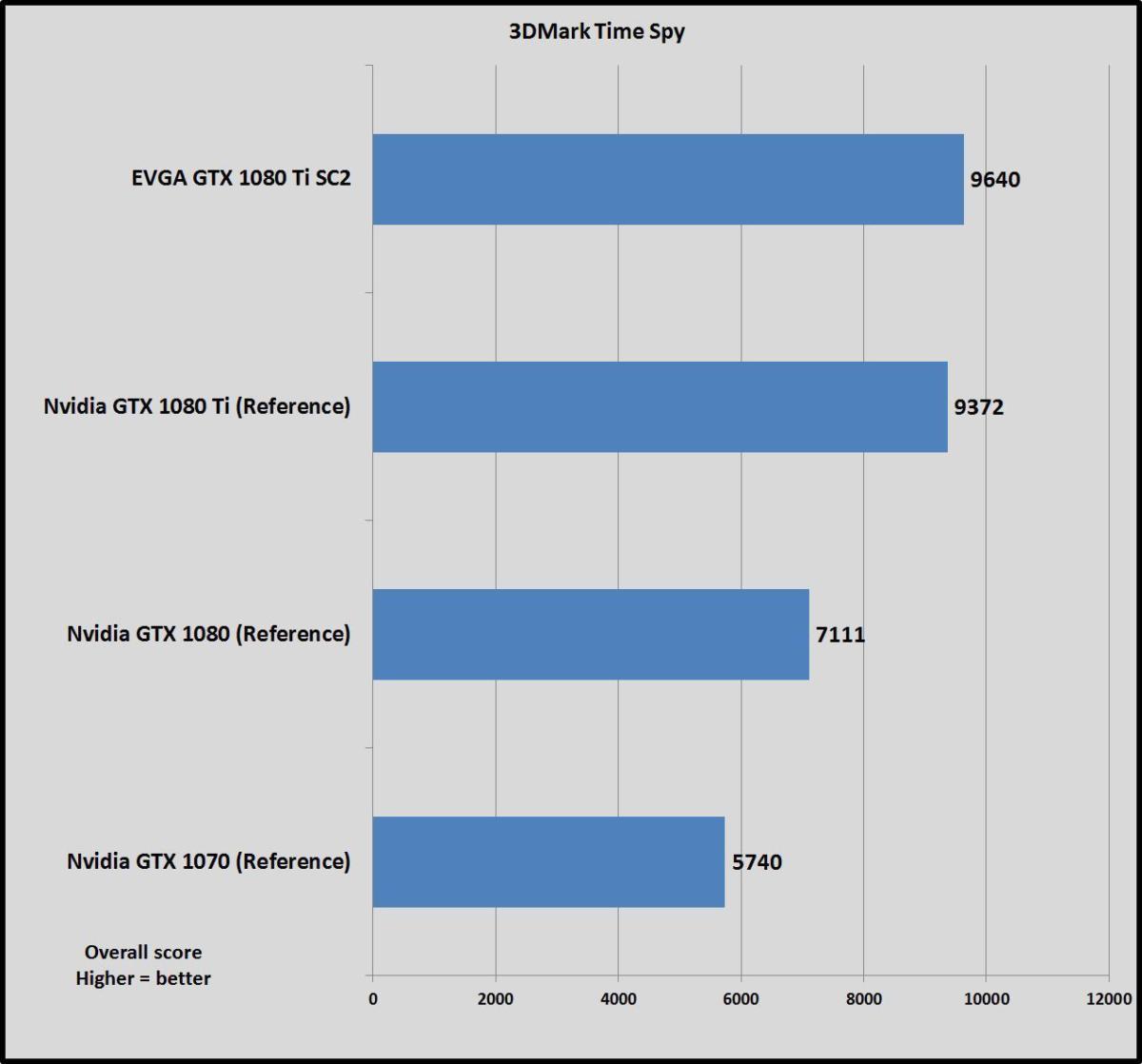
We also tested the EVGA GTX 1080 Ti SC2 and its rivals using 3DMark's highly respected DX11 Fire Strike and Fire Strike Ultra constructed benchmarks, every bit well equally 3DMark's Time Spy benchmark, which tests DirectX 12 performance at 2560×1440 resolution.
 Brad Chacos/IDG
  Brad Chacos/IDG
 Everything falls near where yous'd expect based on prior functioning results.
Next page: Power and heat
Power
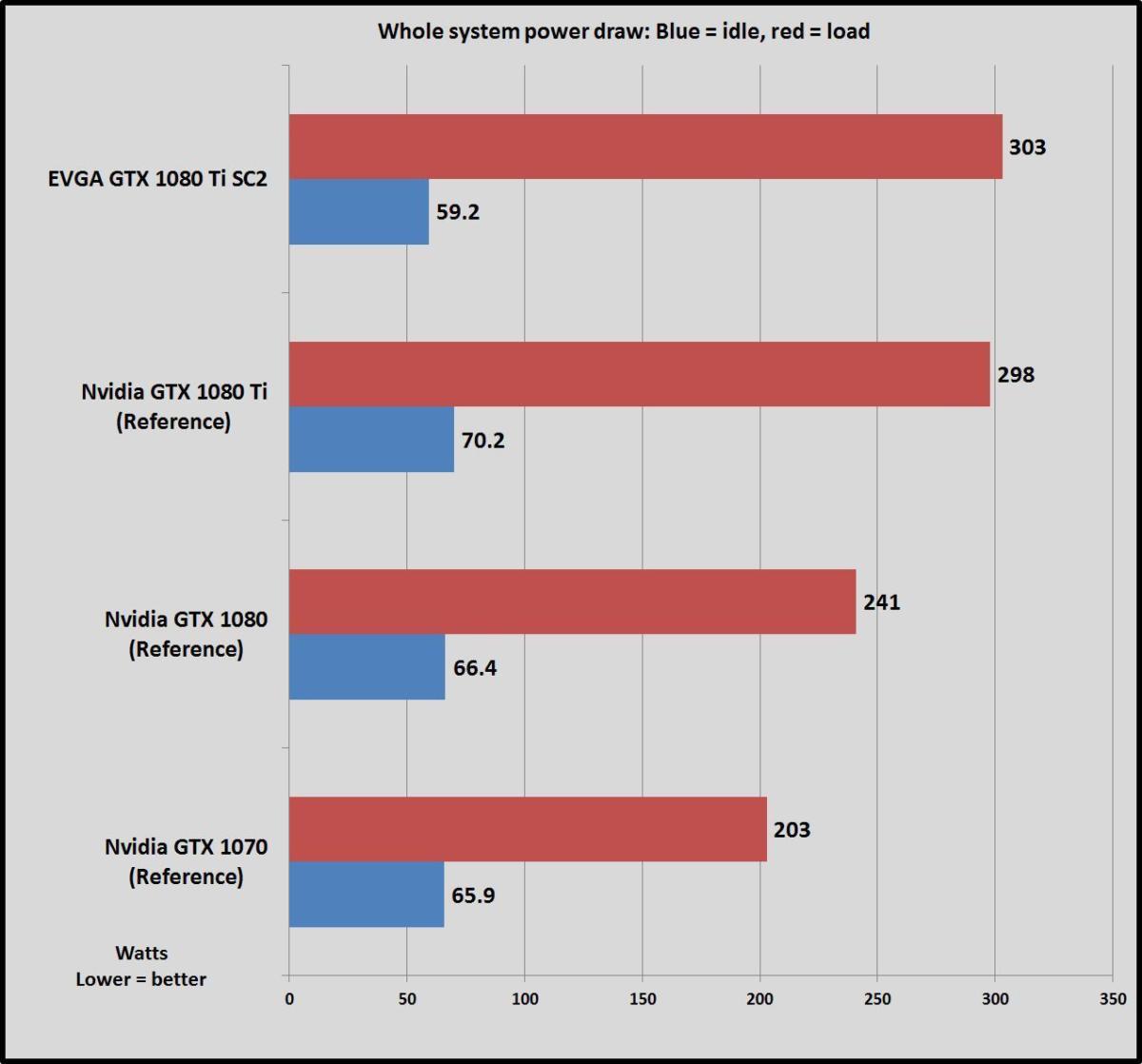
We examination power under load by plugging the entire organisation into a Watts Upwards meter, running the intensiveDivision benchmark at 4K resolution, and noting the peak ability draw. Idle power is measured afterwards sitting on the Windows desktop for three minutes with no actress programs or processes running.
 Brad Chacos/IDG
 The EVGA GTX 1080 Ti SC2 only uses a pilus more power than the GTX 1080 Ti Founders Edition, and a significant 10W less power at idle. That'due south probably because the dual fans on EVGA's card stop spinning when the card isn't under load, whereas the reference model'southward fan constantly whirs.
Rut
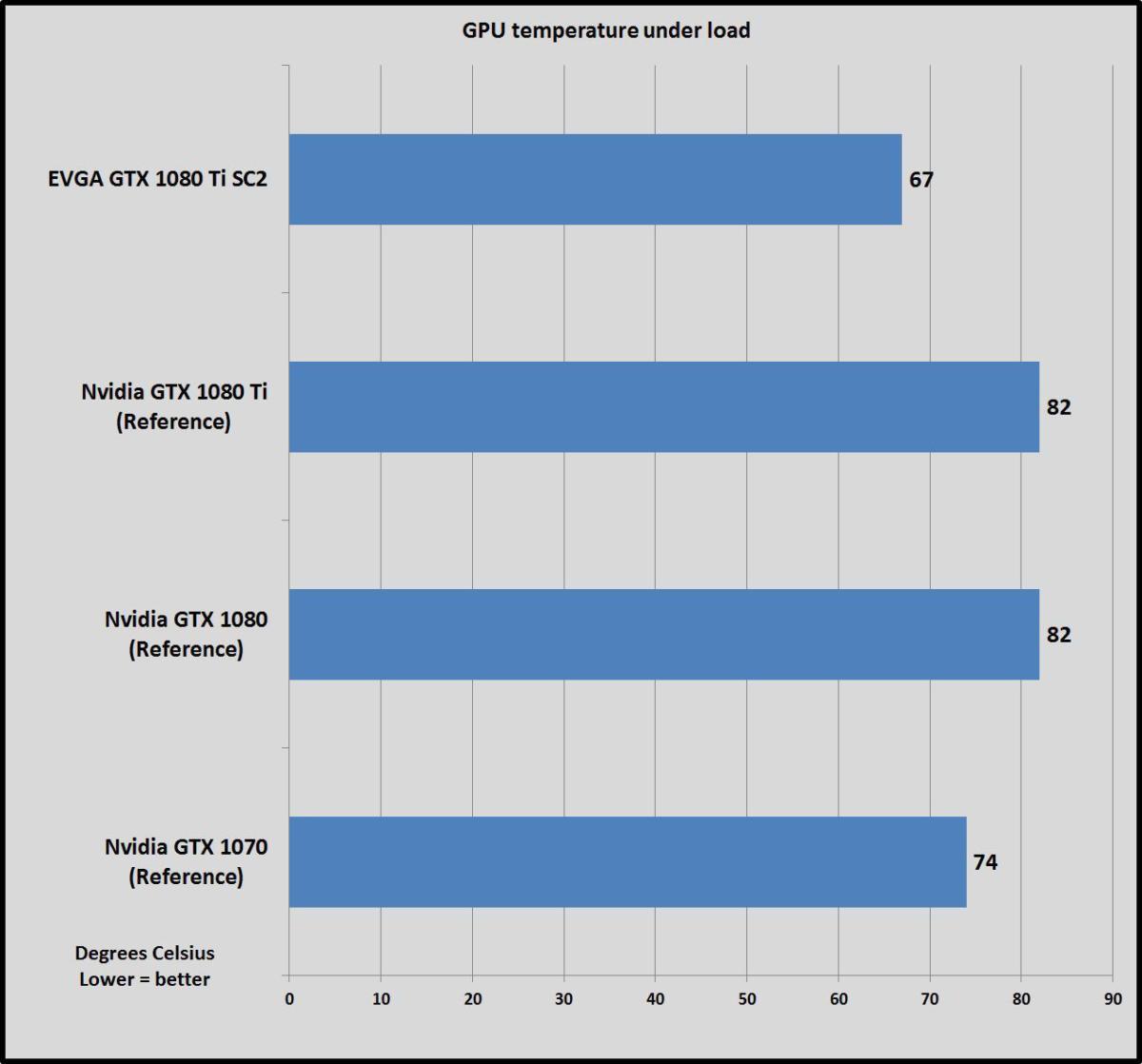
Nosotros test rut during the aforementioned intensiveSectionalisation benchmark at a strenuous 4K resolution, by running SpeedFan in the background and noting the maximum GPU temperature (in Celsius) in one case the run is over.
 Brad Chacos/IDG
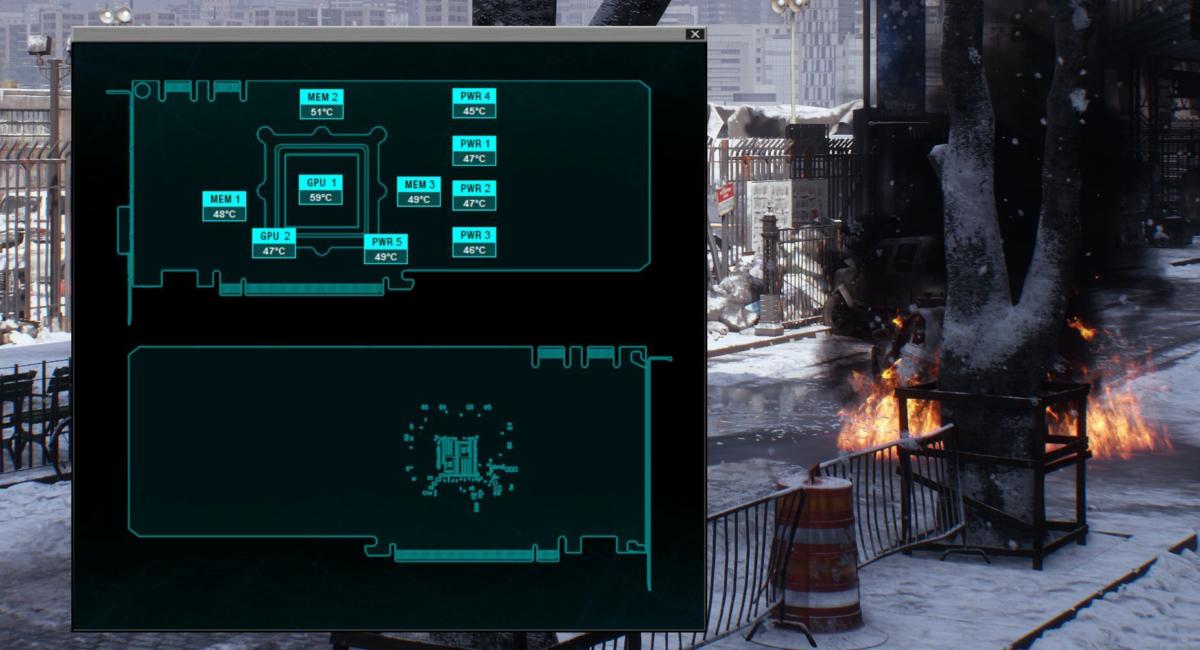
 The EVGA GTX 1080 Ti SC2's robust iCX cooling solution keeps the GPU a whopping xv degrees Celsius cooler than the Founders Edition under load, and information technology stays far quieter while doing so. It'southward not merely the GPU staying dank, either: Checks with Precision XOC showed the PWMs and retentivity running prissy and absurd. I was hoping to snag a shot of the card blaring a ruddy RGB indicator light but couldn't become information technology to happen nether any reasonable circumstances, even afterward overclocking.
 Brad Chacos/IDG
 Precison XOC'south sensor temperature readings while running our thermal examination, a.k.a.The Partitionat 4K repeatedly. (Click to overstate.)
That'south using the default fan curve, besides. Precision XOC allows you to set a custom fan bend, or enable an "ambitious" fan curve. The aggressive curve, which I used in my overclocking endeavors, is no joke: It kept the overclocked GPU running between 52 and 59 degrees Celsius in The Sectionalization and Ascension of the Tomb Raider even at 4K/Ultra. Air-cooled graphics cards don't get much colder than that—though the fan dissonance generated using that setting is just equally aggressive.
Next page: Overclocking and bottom line
Overclocking
Unfortunately, time constraints prevented me from fine-tuning the perfect overclock with the EVGA GTX 1080 Ti SC2. Without tweaking the power limit—an important notation—I was able to attain a +80MHz offset on the card'due south GPU clocks, which resulted in actual clock speeds of 1,910MHz to i,987MHz in games depending on the resolution and intensity of the scene. Retentivity overclocks hitting +300MHz without a hitch, and could've gone farther if I had time to keep stepping upwards the frequency and checking stability.
Fifty-fifty overclocked, EVGA's aggressive fan bend kept temperatures in the mid- to high-50s, Celsius. The combination of the overclock and using the aggressive fan curve also didn't use much more power than the stock configuration, at 314W instead of 303W.
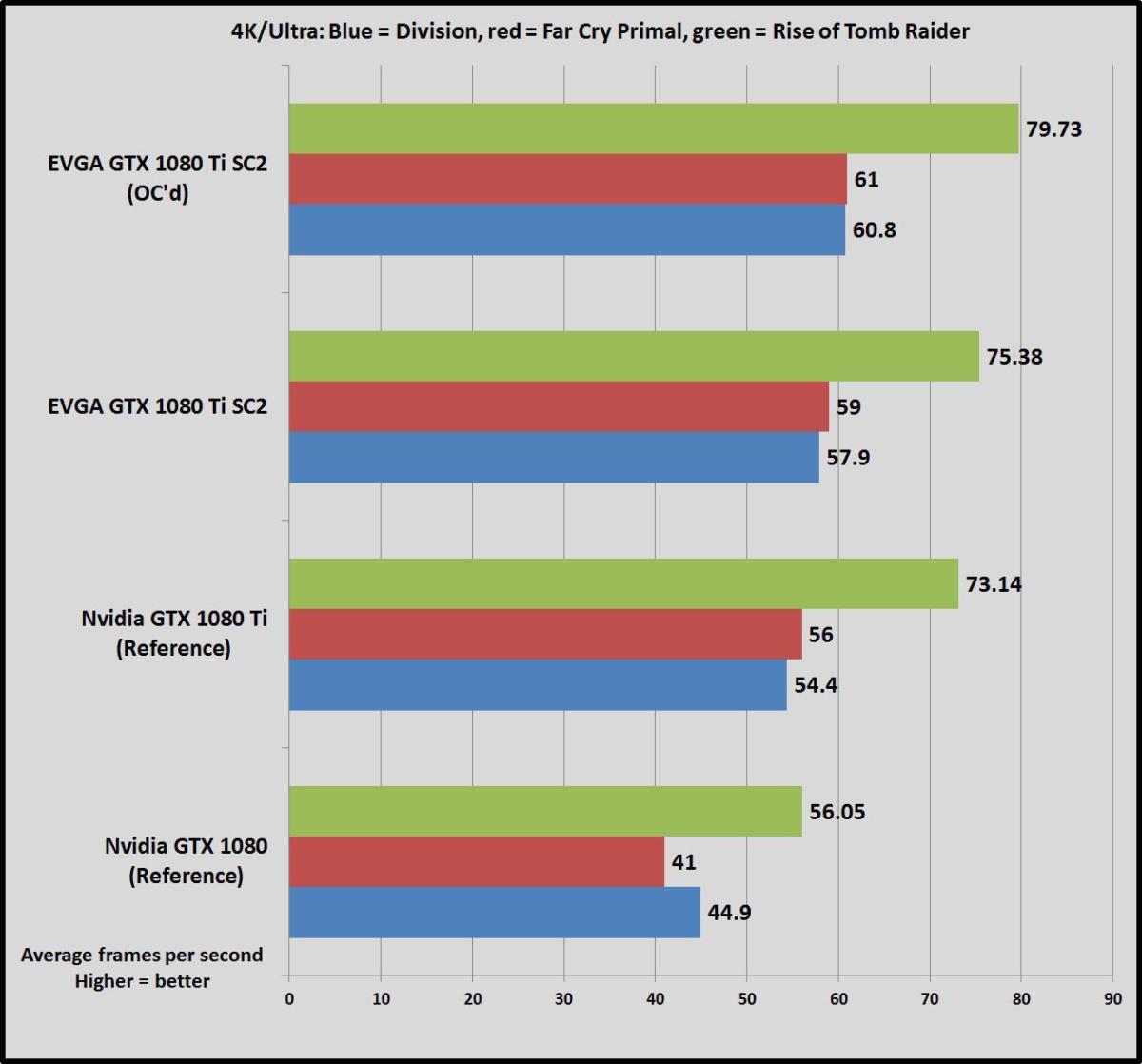
This hasty overclock added a few more than frames' worth of performance in the handful of games I was able to test at 4K/Ultra.
 Brad Chacos/IDG
 Brief overclocking results.
The extra oomph provided by the overclock resulted in a 9.nine percent average frame rate increase compared to the stock GTX 1080 Ti Founders Edition, and no incertitude with time I could've pushed it fifty-fifty further. Not also shabby.
Oh, and I tested Ashes of the Singularity at 1440p with the overclocked EVGA SC2 and saw virtually no divergence in performance still again. Yes, it's CPU-bound.
Bottom line
The EVGA GTX 1080 Ti SC2 kicks ass.
 Brad Chacos/IDG
 Certain, information technology's but an boilerplate of five.vii percentage faster than the GTX 1080 Ti Founders Edition out of the box, but even that modest increase is enough to push The Sectionalisation and Far Cry Primal to the edge of lx fps at 4K resolution with all the graphics options cranked to 11—and push Ashes of the Singularity into being CPU-leap at 1440p. A quick, basic overclock nearly doubled the performance gain, though overclocking'due south always subject to the whims of the silicon lottery.
The real star here is EVGA's unique iCX cooling solution. I was a fan (har har) when EVGA debuted iCX, and the refinements in the GTX 1080 Ti SC2 really get in smoothen. The menu runs absurd equally a cucumber and tranquility as a mouse with its default fan profile, and that's all the more impressive when you consider that the EVGA GTX 1080 Ti SC2'south a standard 2-slot size. Most of the other custom GTX 1080 Ti cards released expanded to bulkier 2.5- and 3-slot thicknesses to adapt the heat of this potent GPU.
 Brad Chacos/IDG
 If yous're actually looking to crank overclocks every bit far equally possible, you might desire to expect for the release of EVGA's flagship GTX 1080 Ti FTW3 flagship, which is also imbued with iCX. That card offers slightly college out-of-the-clock speeds simply actually caters to overclockers by swapping out the secondary vi-pin power connector with another 8-pin connector, upgrading the power phases to a ten+2 arrangement, and calculation a second BIOS. Information technology costs $thirty more, though.
You can't exist disappointed with a cool, tranquility, eminently configurable graphics card that pushes performance to the literal brink in a game like Ashes, though. The GTX 1080 Ti SC2'due south functioning bump and vastly improved cooling solution make it well worth the $twenty premium over a Founders Edition card. EVGA'due south carte du jour is hands the fastest graphics menu to ever cross our labs. Don't hesitate to buy it if you're gaming at 4K resolution, or 1440p at a loftier refresh rate.
And we won't hesitate to upgrade our testing system. Expect for a rebuild earlier Radeon Vega lands, complete with a new lineup of game benchmarks.
Notation: When you buy something afterwards clicking links in our articles, we may earn a small commission. Read our chapter link policy for more details.
Source: https://www.pcworld.com/article/406500/evga-gtx-1080-ti-sc2-review-a-ferocious-graphics-card-with-a-radical-cooler.html

Post a Comment for "Evga 46 Out of 5 Stars 648reviews Evga Geforce Gtx 1080 Ti Sc2 Gaming 11gb Gddr5x Reviews"