When Will He Start Talking to Me Again
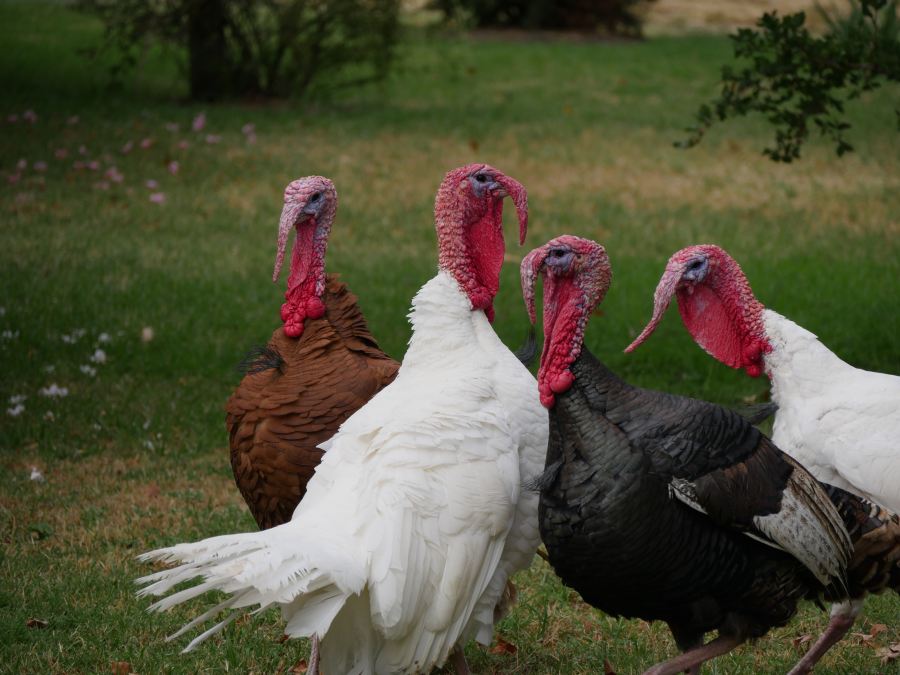
Although many people mistakenly call large groups of turkeys a gaggle or flock, they're technically referred to as a rafter according to the National Wild Turkey Federation. That'due south non the just interesting fact you might be surprised to find about these distinctive birds. Check out these facts to see how much you know about turkey trivia.
What's In a Name
Did y'all e'er wonder where the turkey got its proper name? While turkeys are native to North America, the birds received their name in honor of the country, Turkey. When early on American visitors came across the birds, they saw animals that looked similar to birds from home called "Turkey birds."
Turkey birds are related to African guinea fowl that traveled through Turkey to settle in Europe during the Middle Ages. The similarity betwixt the European Turkey bird and the Due north American bird caused the proper noun to stick
T he Turkey/Dinosaur Link
Making a wish on a turkey's wishbone is a fun tradition shared by many people afterward enjoying a turkey feast. That wishbone is more than just a passing game. It's a direct link to the turkey's prehistoric lineage, as suggested by Live Science. It turns out, the Tyrannosaurus rex and Veliciraptors likewise had a wishbone, as well known as a furcula.
T urkeys Nearly Became Extinct
At 1 time, experts guess around ten 1000000 turkeys lived in the U.s.. Subsequently the arrival of the early on settlers, that population slowly dwindled. Past the 1930s, hunting and evolution that destroyed the habitat of wild turkeys nearly drove these birds to extinction. Conservation efforts were successful and the wild turkey population is at present somewhere around seven million according to what wildlife biologist Tom Hughes said in an interview with The Dodo.
T urkeys Get out the Nest at a Young Historic period
Babies, which are called poults, are built-in with feathers. Poults are self-sufficient so speedily that the young birds typically get out the nest within around 24 hours. Poults go out with their mothers to find food. A male turkey rarely plays a role in raising its young. The boilerplate lifespan of a turkey is three to five years, although the oldest wild turkey on record lived to 13 years of age, co-ordinate to The Spruce.
G obble, Gobble
Did yous know that one of the means to tell the divergence between male person and female person turkeys is to listen to their gobble? Males produce the distinctive audio to denote their arrival to females, communicate with his rafter and to warn of danger. That'southward why males are typically called gobblers, while females are chosen hens. Likewise notable—a turkey'south gobble is so loud that it can be heard from up to one mile away.
B enjamin Franklin Respected Turkeys
One of America's Founding Fathers, Benjamin Franklin, had such respect for these birds that he would have preferred the turkey equally the nation's symbol instead of the bald hawkeye, as noted by Live Science. He wrote a letter to his girl that indicated he felt that turkeys were more respectable birds in comparison to eagles. He also was a fan of the turkey's native status. While eagles had been plant in other countries, turkeys were specific to America.
B lushing Wattles
The exposed peel on a turkey'due south head and neck, normally called its wattle, changes color according to a turkey'due south mood. During mating flavor, male turkey's wattles plow to a brilliant ruddy in response to sexual hormones. In times of illness, fear or agitation, the snood (that odd fleshy project on its forehead) can transform from its normal blue-grey or pale pink color to bright carmine, white or blue.
Source: https://www.reference.com/pets-animals/large-group-turkeys-called-4f8b4a81901c461?utm_content=params%3Ao%3D740005%26ad%3DdirN%26qo%3DserpIndex

Post a Comment for "When Will He Start Talking to Me Again"